
I’ve been playing around with various AI tools for a little over a year now. While I see their benefits in specific use cases, one thing that really bothered me was the idea of generated AI art (of which I am not a fan for many reasons). One of my concerns is losing that part of me (and all humans but more about this in a future post) that always enjoyed creating art. Be it a cartoon character, a painting, or even an infographic.
My iPad quickly became my go-to powerhouse for production back when the Apple Pencil was put on the market. This was partly due to the fact that I was focussing on creating Franky Banky comics for my audience across social media accounts. Using my iPad, an Apple Pencil, and the Procreate app saved me a heck of a lot of time from having to manually layout paper, pencil things in, erase, ink, fix any errors with Liquid Paper, scan, clean up, adjust, and make redraw a few things that need drawing and repeat. I could do all that while I digitally inked a comic. I’d draw a rough sketch on one layer and ink on another layer above it and make all necessary adjustments by erasing and redrawing parts. Much like touching up a photo in Photoshop. This was a real time saver since my Franky Banky work is my spare time side hustle.
However, I realized I was craving a physical connection to my work. I missed the tactile nature of drawing. And the skill needed to draw a permanent mark on a paper and try not to make any mistakes.
I felt I had too much technology in my life, both personal and professional, by the time AI tools like ChatGPT, Claude, Perplexity, Gemini, etc., had arrived. Everything took place in a screen. In the virtual world. Hardly in the real world. And these AI tools make it way too easy to outsource your talents. Just write a prompt . Yes, it’s nice to be able to whip up an email in a matter of seconds and tweak as per your liking, however, I feel something has been lost in the old way of writing from scratch.
While excess screen time brought on a bit of a non-tactile fatigue, it got me back into drawing with paper and a pencil. And a pen. And a brush pen. It feels so good to be back.
I still use my iPad for my social media stuff (industrialised art) but now I’m making time for what makes me human. This is partly because there’s a prediction made in some artist circles that seems to already be coming true – more people will end up wanting authentic human-made art over AI generated stuff.
Industrialised content
So I decided to use AI tools for work and business. After all, I see the value in efficiency as anyone, time is money, etc., and if an AI tool can speed up the lesser enjoyable aspects of a project, hey why not?
For personal creative expression? I’ve found it’s not quite my cup of tea. I miss that sense of personal “authorship” whenever I experimented with AI-generated assets. I missed the intentionality of every stroke and line rather than just directing code to assemble pixels for me. That’s why I’m choosing to avoid another ‘Apple Pencil habit’ because I’ve learned that while convenience is great, there’s a specific kind of connection that only happens when a human makes the choices. Imperfections and all.
My animation conundrum
One of my goals with Franky Banky is to start making animated cartoons. Thanks to the creators of Procreate, they gave us Dreams, an animation app. I haven’t yet been able to dabble in it a little more, however, in the meantime, I couldn’t help but find myself thinking if there would be an AI tool that could speed things up.
I don’t like that idea at all. After all, my love for animation came from the fact that humans made my favourite cartoons with their own hands. It’s a marvel of human feat and physics that brought this art form to life.
A few animation studios, including Disney, had announce they would be using AI in their films. Very controversial in the art space. As the industry evolves, I wanted to find a way to stay true to my roots while using new tools to handle the ‘grunt work.’
How can I reconcile this kind of philosophy of removing humanity from the equation?
Enter my friend, Jeremy Wright.
He’s a mix of marketer, strategist and, tinkerer (and oh, he’s absolutely worth hiring), who also has been doing deep dives into AI tools for his work in his field. Recently, I marvelled at a project he worked on and picked his brain about it. As a demonstration, Jeremy kindly threw together a similar project based on my work in cartooning.
I wonder if he knew that he would end up answering my conundrum.
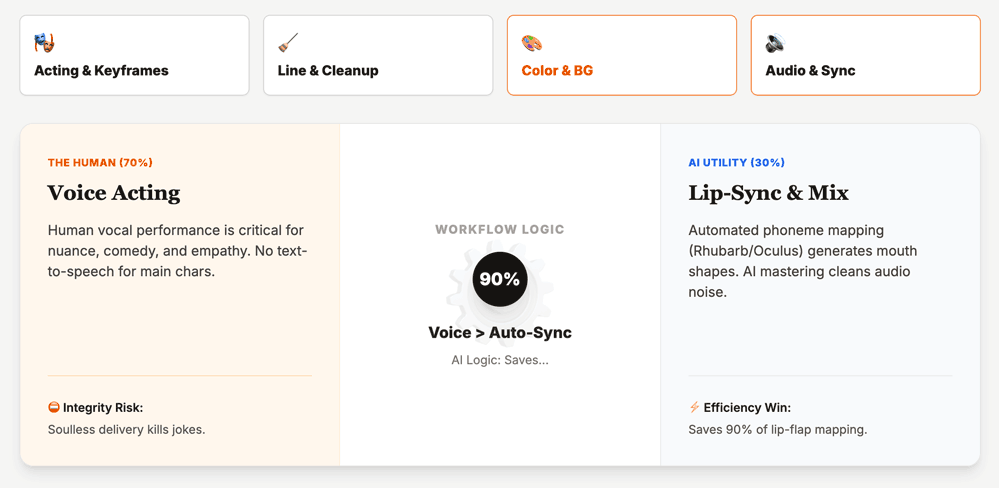
He used Gemini and NotebookLM to brainstorm a “hybrid-human” model for the animation landscape. Long story short, in minutes, Jeremy’s research presented a 30/70 rule for animation companies that leverages 30% AI to amplify and not replace 70% human creativity. Complete with risk assessment (because according to research, viewers begin to disengage with synthetic content than with human-generated art).
A few highlights include:
- “Audiences are rejecting smooth, synthetic AI interpolation” (yay! – editor’s note). “There is a premium on ‘crunchy,’ hand-drawn lines and visible human effort.” This last part is what also brought me to draw with a brush pen on paper. Digitally inked lines don’t have that more appealing imperfect human-drawn look.
- “The artist draws key poses. The ‘Soul’ of movement—timing, spacing, exaggeration—comes from the human hand.” AI can be used to smooth specific actions and segments.
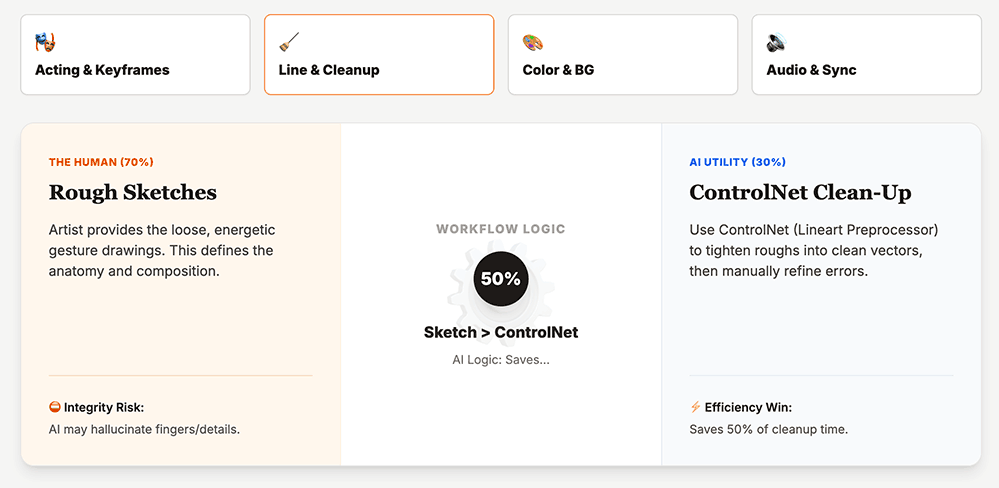
- “Artist provides the loose, energetic gesture drawings. This defines the anatomy and composition.” AI can be used to tighten roughs into clean vectors, then artists can manually refine errors. This is something I’ve recently wished for when I was designing an app icon in Adobe Illustrator! See? Industrialised art needs efficiency. Personal creative expression doesn’t (unless you’re in a rush or something!).
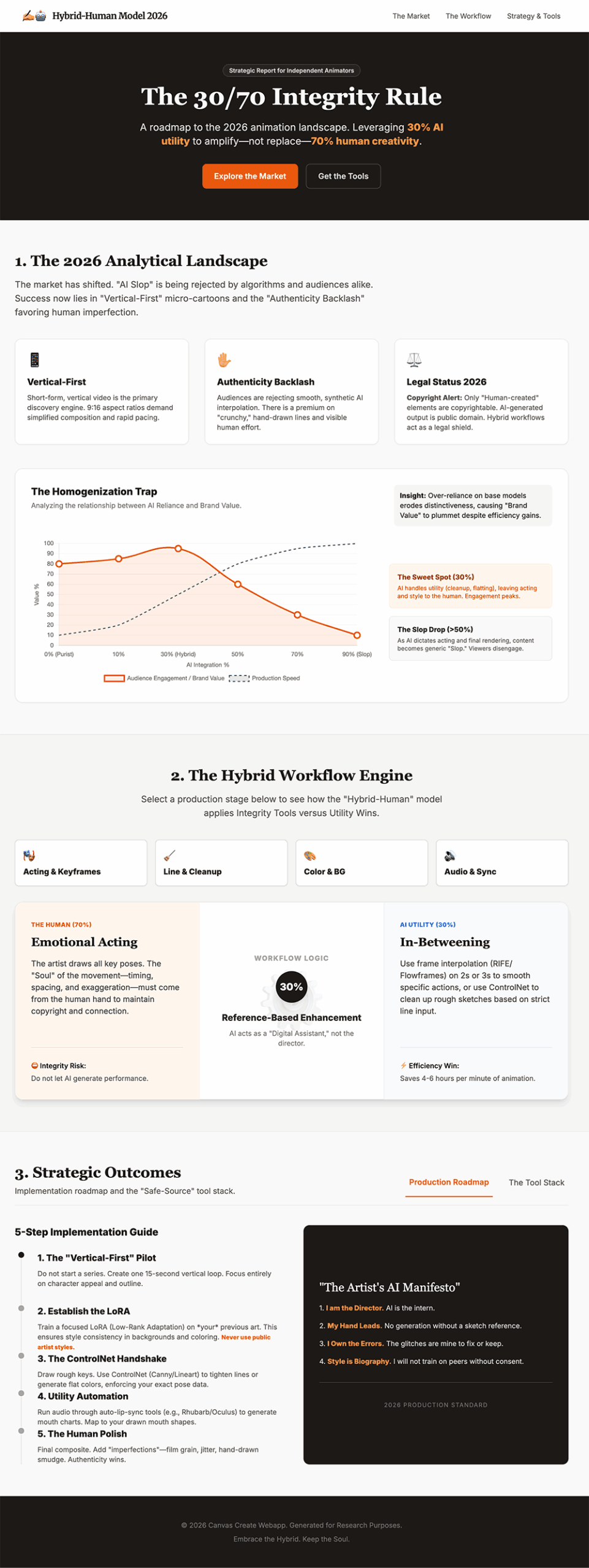
Now THIS makes sense to me!
The human creative mind is still in control and the AI tool acts as the intern. Does this take away jobs from interns and entry-level animators? Maybe. Maybe not because anyone at any level can use these tools and publish to the world and build a community just like the big companies.
And most likely better because they’ll have the efficiency of a studio and the soul of an individual creator!
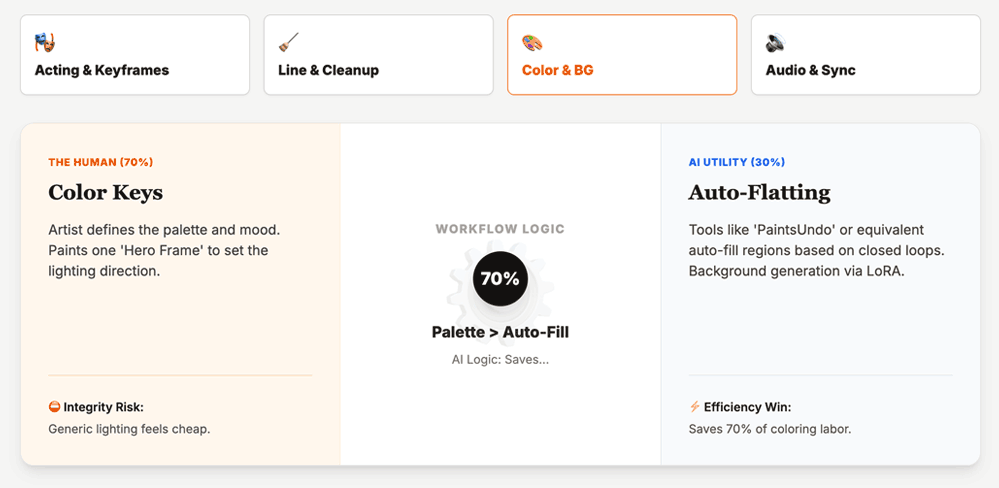
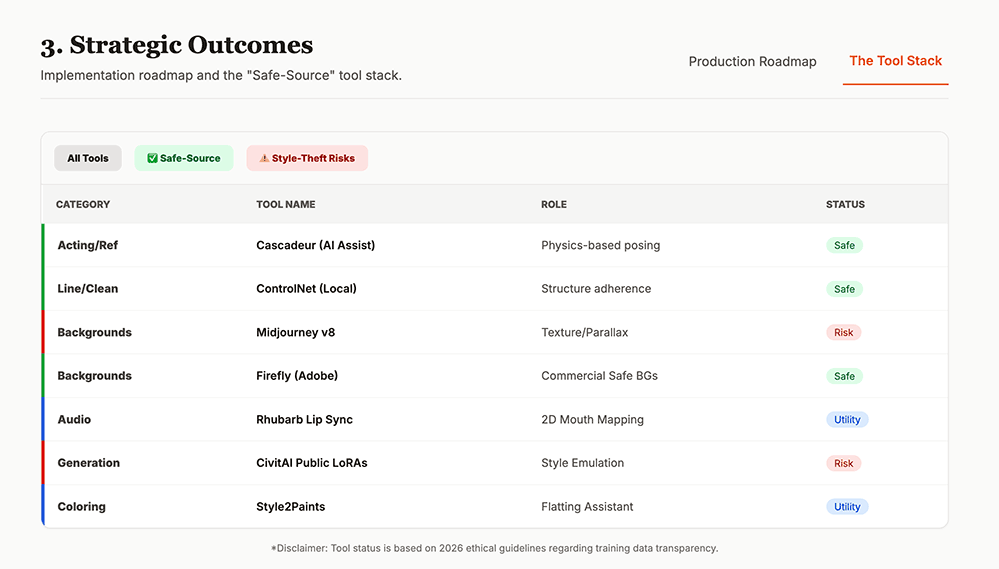
A few close-ups to show dynamic content with details on how AI tools can be used in various production stages throughout the animation process along with risks:
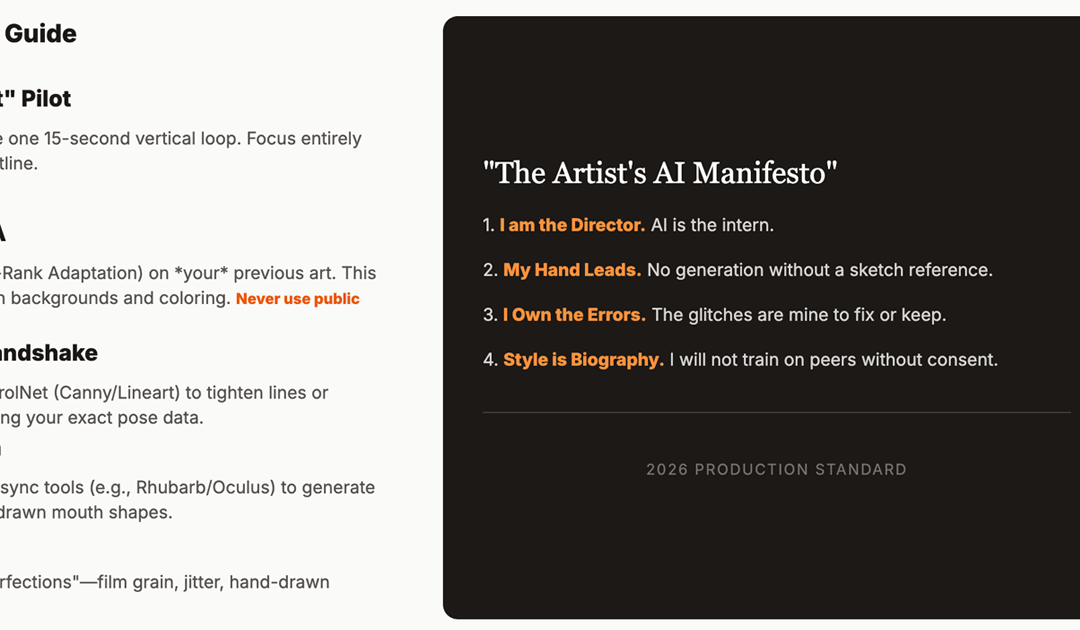
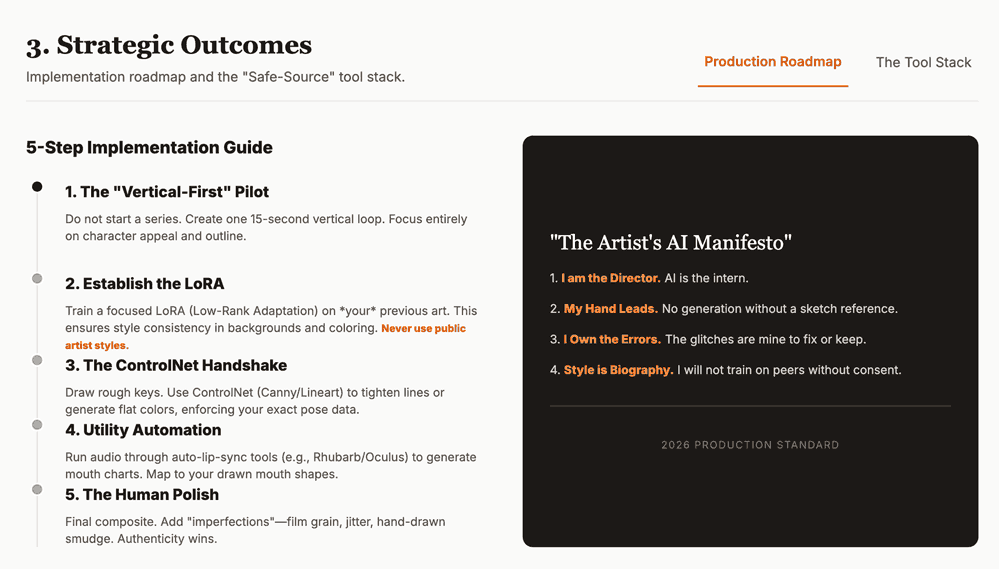
I really like the Artist Manifesto:
- I am the Director. Al is the intern.
- My hand leads. No generation without a sketch reference.
- I own the errors. The glitches are mine to fix or keep.
- Style is biography. I will not train on peers without consent.
My next steps
The main takeaway I got from Jeremy’s example is AI tools can definitely help with pretty much anything you may need help with. This resonates with me very much since one of my workplace personality traits is strategic. I can’t help but come up with ideas and tactics for business, content engagements, storytelling, what-have-you, and like Jeremy, I like to tinker and try them out. Hence, how I started my Franky Banky side hustle.
So I’ll continue to tinker with various AI tools and see how they can assist in my strategic endeavours. As for animated Franky Banky cartoons, maybe. Dreams already has impressive keyframing features which seem to fulfill my needs but as a tinkerer, I can’t help but to keep my eyes open for opportunities.